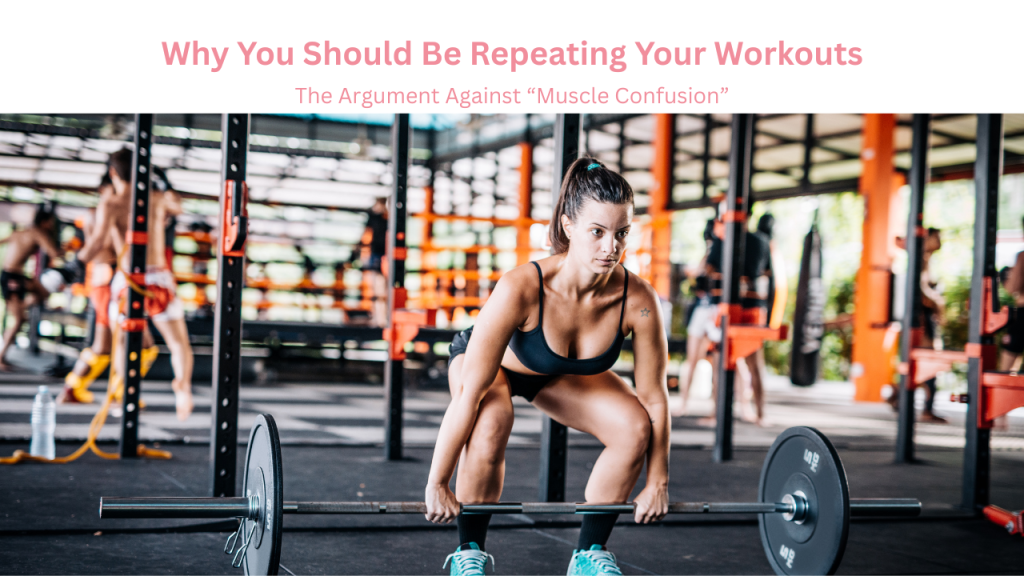
If you were anywhere near a TV in the early 2000s, you probably remember P90X and its famous tag line: “muscle confusion.” The idea was simple and catchy – never let your body adapt, keep it guessing, switch things up constantly, and you’ll never plateau.
It sounded smart. It sold a lot of DVDs. It’s also not really how muscles work.
The Kernel of Truth
As with most fads in the health and wellness space, the concept behind “muscle confusion” has a kernel of truth. It’s a repackaged, oversimplified version of a real training principle: progressive overload, layered with some ideas about training variation. Your body absolutely does need new stimulus over time to keep improving. That part is true.
But P90X took that legitimate concept and flipped it inside out. Instead of building a plan where your body adapts and gets stronger over time, the program kept yanking the rug out before adaptation could even happen. You’d never do the same workout twice in a row, never build on what you did last week, never really know if you were getting stronger – because you were too busy learning a brand-new routine.
Constant novelty isn’t a training principle. It’s the opposite of one. Your muscles, joints, and nervous system don’t get better by being confused. They get better by being challenged in a structured, progressive way – and doing something similar enough to the last workout that you can push it a little further.
What We Do Instead: Real Programming
At StrongGirl Revolution, our programming is built around 4-6 week training cycles, and each cycle has a purpose:
- Hypertrophy cycles – building muscle, focusing on volume and time under tension
- Strength cycles – building raw force production, focusing on heavier loads and lower reps
- Hybrid cycles – blending both, so you’re building size and strength at the same time
Progressive Overload Explained
Progressive overload is the principle that your body only changes when you consistently ask more of it than it’s used to. That “more” can look like a lot of things – a heavier weight, an extra rep, a slower rest period, one more set. The specific lever doesn’t matter as much as the pattern: small, trackable increases over time, on top of movements your body already knows how to do well.
That last part is the piece “muscle confusion” completely missed. Progressive overload requires familiarity. You can’t meaningfully overload a squat you did for the first time yesterday – you’re still learning the movement, not testing your limits in it. Real progress happens when a movement becomes familiar enough that you can push it, measure it, and build on it week after week. That’s why our cycles run 4-6 weeks instead of changing daily: it’s long enough for your body to learn a movement pattern and then get measurably stronger or bigger within it, but short enough that we can rotate in a new stimulus before you plateau.
In practice, this means we’re always able to answer the question P90X never could: are you actually getting stronger than you were last month? With us, the answer is trackable – more weight on the bar, more reps at the same weight, better control through a harder variation. That’s the whole point.
Why Mobility and Stability Aren’t “Extras”
It’s easy to think of mobility and stability work as the warm-up stuff you rush through to get to the “real” lifting. We build them into every cycle on purpose, because they’re actually what makes the strength and hypertrophy work possible – and safe – long term.
Mobility is your ability to move a joint through its full range of motion with control. Without it, your body compensates: your lower back rounds to make up for the tight hips, your shoulders creep up to make up for a stiff upper back. Those compensations are exactly where injuries come from, and they also cap how much weight you can safely move, because you’re leaking force through a joint that can’t get into the right position in the first place. Training mobility isn’t separate from getting stronger – it’s what lets you access the strength you’re building.
Stability is your ability to control a joint or your core while force is moving through it – not just holding a plank, but staying braced and aligned while you squat, press, or carry something heavy. Without stability, your biggest, most powerful muscles are working on a shaky foundation. It’s the difference between a heavy lift that’s controlled and a heavy lift that’s one wrong angle away from an injury. It’s also, frankly, what allows you to keep training consistently – the people who stay in the gym for years, not months, are usually the ones who trained stability alongside strength from the start.
Power Isn’t Just for Athletes
When people hear “power training,” they usually picture Simone Biles or Serena Williams. But power – the ability to produce force quickly -isn’t a niche athletic skill. It’s a foundational one, and it matters just as much for the everyday woman as it does for anyone competing on a field.
We program power in various places in the workout, but for the average woman we program them in the beginning of the workout. Programming the power movements early in the workout, before the heavier strength or hypertrophy work, primes your central nervous system. The explosive movements wake up the fast-twitch muscle fibers and neural pathways you’re about to rely on for your heavier lifts, so you can walk into that workout better prepared to move real weight.
Power also trains something a lot of programs skip entirely: reaction time. Life doesn’t ask you to move slowly and predictably – it asks you to catch your balance on the curb you didn’t see, react to a dog darting into your path, stop yourself from a stumble. Power training builds exactly that kind of quick, controlled response, which makes it one of the most practical tools you have for preventing falls and reacting well when your environment suddenly changes.
And there’s a long-term payoff, too: power movements have been shown to help stimulate bone mineral density. That’s not a small thing – it’s a direct proactive way to build toward stronger bones and push back against conditions like osteoporosis down the road.
Power isn’t the flashy add-on. It’s protections you’re building now for the body you’ll have in twenty years.
And every single workout in our program is full body. No isolated “arm day” or “leg day”. Those types of split routines are great for body builders. But your body doesn’t live in an isolated silo, and neither should your training.
The Bottom Line
You don’t need to be confused to make progress. You need a plan that builds on itself – one where this week’s workout sets up next week’s, and next week’s sets up the one after that. That’s not as flashy or sexy as a new routine every single day, but it’s what actually makes you stronger, more capably, and more resilient over time.
Confusion sells DVDs. Progression builds strength.
If you’re not seeing results in your workout, come check us out and see how our program can help you.